

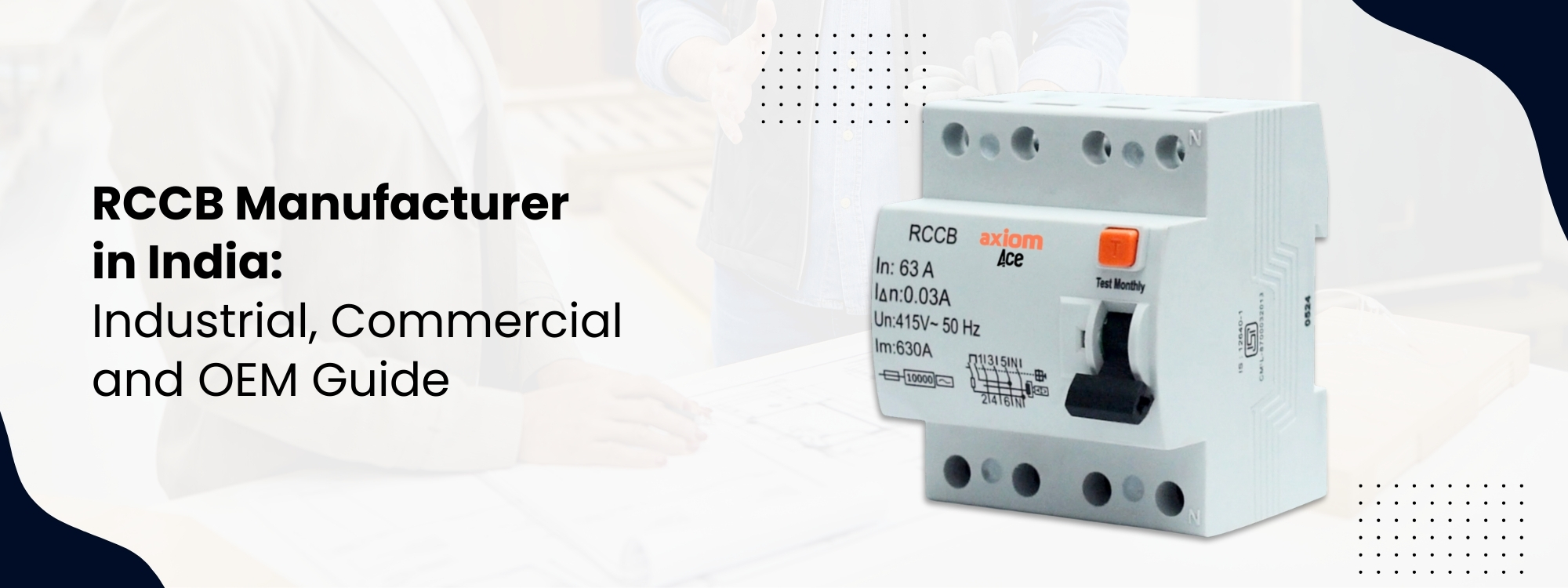
Residual Current Circuit Breakers (RCCBs) are a critical component of modern electrical safety systems. For industrial facilities, commercial buildings, and OEM panel builders, sourcing RCCBs directly from a reliable manufacturer ensures consistent performance, regulatory compliance, and long-term safety.
This guide explains the role of an RCCB manufacturer, key evaluation criteria, customization capabilities, and how industrial buyers select the right manufacturing partner.
What Does an RCCB Manufacturer Do?
An RCCB manufacturer designs, tests, and produces residual current circuit breakers that disconnect power when earth leakage current is detected. Unlike distributors or traders, manufacturers control:
- Product design and engineering
- Compliance with IEC and Indian safety standards
- Factory testing and quality assurance
- Bulk and OEM supply capability
This control ensures predictable performance across large-scale electrical installations.
Why RCCBs Are Essential in Electrical Systems
RCCBs protect against:
- Electric shock hazards
- Fire risks caused by leakage currents
- Equipment damage due to insulation failure
They are commonly used alongside MCBs to provide comprehensive electrical protection in industrial, commercial, and residential distribution boards.
Key Standards for RCCB Manufacturing
When evaluating RCCB manufacturers in India, buyers should verify compliance with:
- IEC 61008 / IEC 61009 standards
- Applicable Indian Standards (IS)
- Factory quality systems such as ISO certification
- Routine and batch testing procedures
Certified RCCBs ensure accurate tripping performance and long service life.
Technical Factors to Consider When Choosing an RCCB Manufacturer
Sensitivity Ratings
Manufacturers should offer multiple sensitivity options, including:
- 30 mA for personnel protection
- 100 mA or higher for equipment and distribution protection
Pole Configuration
- 2-Pole RCCBs for single-phase systems
- 4-Pole RCCBs for three-phase systems
RCCB Types
Reliable manufacturers support:
- Type AC RCCBs
- Type A RCCBs for modern electronic loads
These factors are essential for system compatibility and safety.
Customized RCCB Solutions for Industrial Applications
Many industrial and commercial projects require customized electrical safety solutions. RCCB manufacturers offering customization support:
- Application-specific ratings and configurations
- Compatibility with control panels and distribution boards
- Batch testing and traceability
- OEM and bulk supply requirements
Customization improves system reliability and compliance in complex installations.
RCCB Applications Across Industries
RCCBs manufactured for professional use are deployed in:
- Manufacturing plants
- Commercial buildings and offices
- Infrastructure and institutional facilities
- OEM electrical control panels
- Industrial distribution board
Manufacturers with application knowledge design RCCBs for durability and stable operation under electrical stress.
Manufacturer vs Distributor: Understanding the Difference
An RCCB manufacturer:
- Controls design, testing, and production
- Supports OEM and bulk supply
- Provides technical documentation and certification
A distributor:
- Resells finished products
- Depends on manufacturer data
- Has limited customization capability
Industrial buyers often prefer manufacturers for long-term reliability and technical support.
Axiom Controls as an RCCB Manufacturer
Axiom Controls operates as an Indian RCCB manufacturer supplying electrical safety devices for industrial and commercial applications. The manufacturing approach focuses on:
- IEC-compliant RCCB design
- Factory-tested performance consistency
- Support for OEMs, dealers, and distributors
- Technical documentation for system integration
- Stable bulk supply for large projects
This manufacturing-led model supports long-term electrical safety and compliance.
FAQs:
What does an RCCB manufacturer do?
An RCCB manufacturer designs, tests, and produces residual current circuit breakers according to safety standards.
Are RCCBs mandatory in industrial installations?
In many applications, RCCBs are required to meet electrical safety norms and reduce shock and fire risks.
Can RCCBs be used with MCBs?
Yes. RCCBs are commonly combined with MCBs to provide both leakage and overcurrent protection.
Who should source RCCBs directly from manufacturers?
OEMs, panel builders, industrial contractors, and distributors benefit most from direct manufacturer sourcing.
Conclusion
Selecting the right RCCB manufacturer is essential for electrical safety, regulatory compliance, and system reliability. Industrial and commercial buyers should evaluate manufacturers based on standards, technical capability, customization support, and supply consistency.With a manufacturing-focused approach and compliance-driven design, Axiom Controls supports RCCB requirements for modern electrical systems across industries.